


On September 9th, I had thirty minutes on the Automechanika Frankfurt stage to make an argument that the automotive aftermarket, an industry built for the better part of a century on the simple economics of parts wearing out, is now being reshaped by forces that have almost nothing to do with wear at all. The session was billed as a market briefing on China and ASEAN. By the time I stepped off stage, it had become something closer to a thesis about where the industry's center of gravity is actually heading. Frost & Sullivan's Mobility practice served as the Global Knowledge Partner for this year's show
What the Show Floor Reveals
Automechanika Frankfurt 2026 drew more than 112,000 trade visitors from 173 countries and 4,400 exhibitors from 80 countries, an increase of roughly 4 percent in visitors and 5 percent in exhibitors over the 2024 edition.
The Framework Behind Everything Else
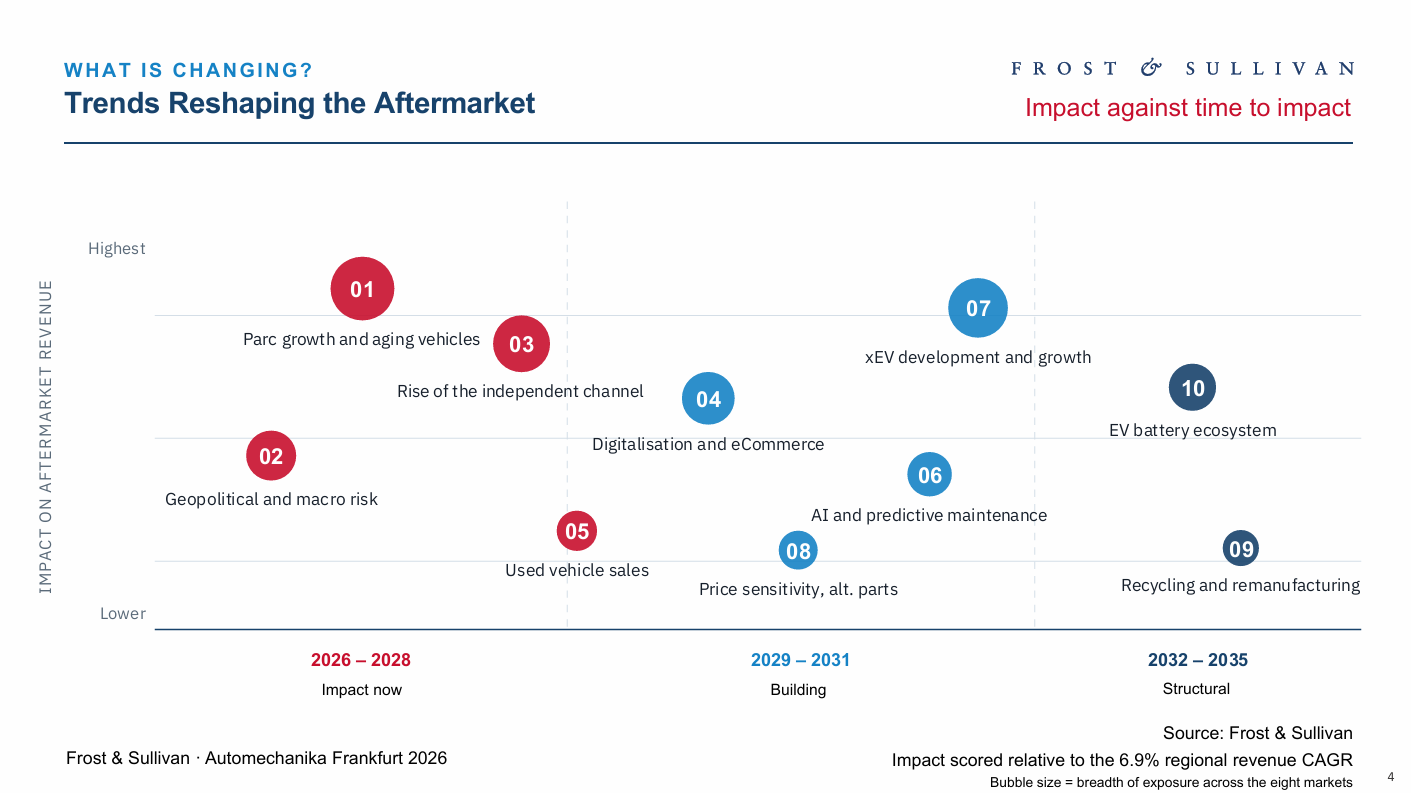
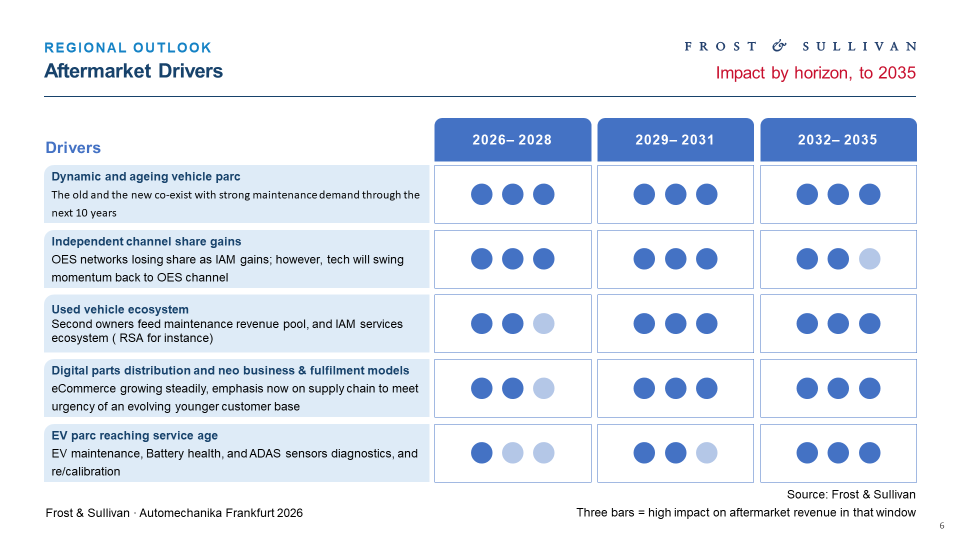
Before any of the individual shifts in this piece make sense, it helps to see the framework we built to organize them. We plotted ten trends against how heavily each one affects aftermarket revenue and how soon that effect actually lands. Parc growth, an aging vehicle base and geopolitical risk are already reshaping revenue today, inside the 2026 to 2028 window. Digitalization, ecommerce and AI led predictive maintenance are still building, arriving in force between 2029 and 2031. EV development, the EV battery ecosystem and remanufacturing are structural, meaning their full weight will not be felt until 2032 to 2035, even though the decisions that determine who wins that window are being made right now.
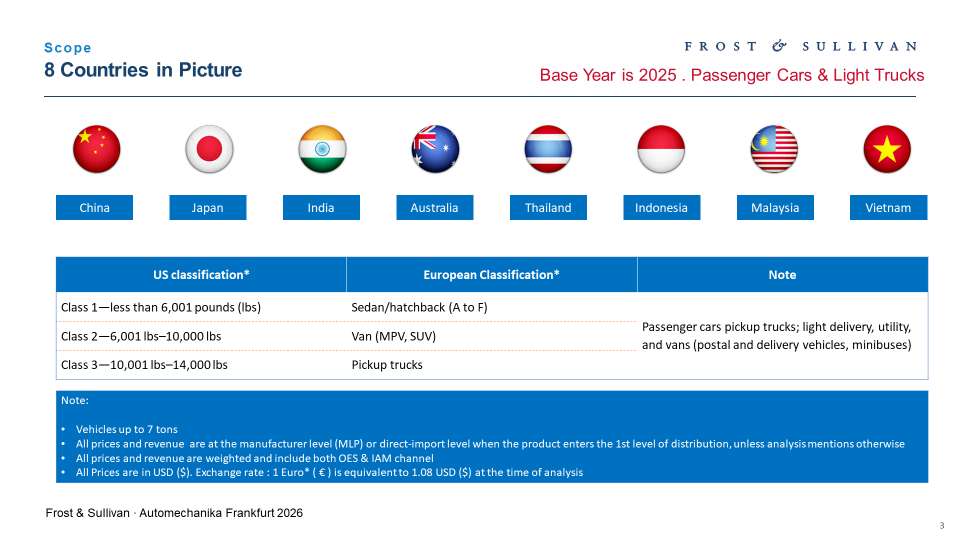
Laid over eight markets, the same ten trends do not move at identical speed everywhere. Parc growth carries high impact in every market we studied without exception. AI and predictive maintenance already carries real weight in China and Japan while remaining a limited factor in Indonesia and Vietnam today. That unevenness is precisely why a single global aftermarket playbook does not work, and it is the lens through which everything that follows in this piece should be read.
The number worth studying is China's share of the exhibitor floor. In 2024, China supplied roughly one fifth of all certified exhibitors at the show, more than any other nation, and it was also the single largest source of foreign visitors. A country that manufactures most of the world's electric vehicles is now sending the largest delegation to Europe's flagship aftermarket trade fair. That is not incidental foot traffic. It is a market committing real capital and real floor space to where it believes the next decade of competition will be fought.
From Torque to Telemetry
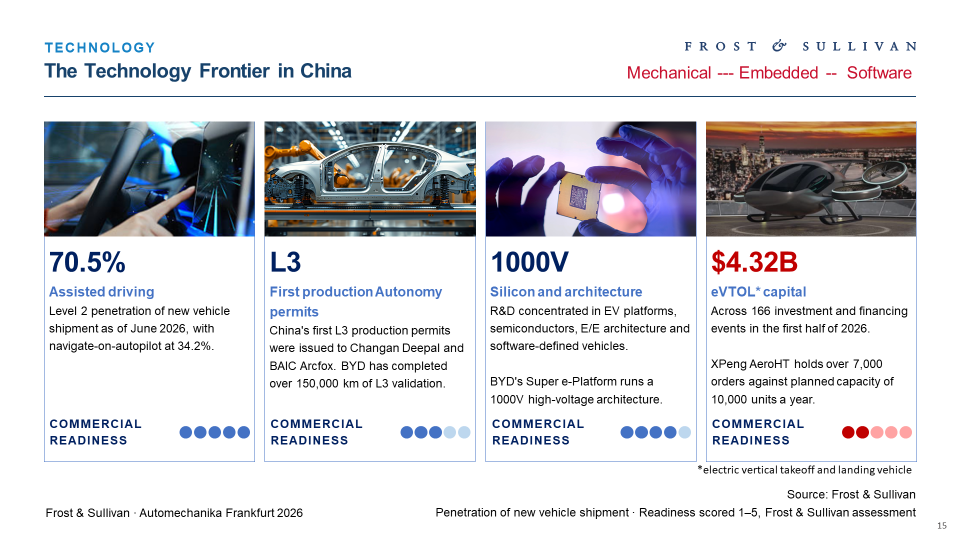
The deepest change underway in this industry has surprisingly little to do with electrification on its own. It has to do with what a vehicle has quietly become. A car sold a decade ago was, functionally, a machine you serviced whenever its parts wore down. A car sold today is a network of control modules, sensors and software that occasionally happens to move under its own power. That distinction matters enormously, because the two objects require entirely different service infrastructure, entirely different technician training, and entirely different parts catalogues.
Industry estimates place automotive electronics at roughly a third of total vehicle cost as recently as a few years ago, climbing toward half of vehicle cost by the end of this decade. Every advanced driver assistance sensor, every battery management unit, every software controlled function is a line item that simply did not exist in the aftermarket a generation ago, and a fault that a wrench alone cannot resolve. I put it plainly on stage: as vehicles shift from purely mechanical systems toward ADAS sensors and EV batteries, they demand a kind of technician who, across most of the markets I study, does not yet exist in sufficient numbers.
“As vehicles shift from purely mechanical systems to ADAS sensors and EV batteries, they demand a new kind of skilled technician, one that doesn't fully exist yet.”
This is not a hiring problem for any single workshop chain to solve on its own. It is a structural shortfall the entire industry will spend the next decade closing, and the companies that close it fastest will own a disproportionate share of the next generation of service revenue.
The Vehicle That Updates Itself
The second force compounds the first. A software defined vehicle does not wait to be brought into a bay. Its defects get patched, its features get added, and increasingly its revenue gets generated over the air (OTA) while the vehicle sits quietly in the owner's driveway. This is no longer a theoretical concern for a future planning cycle. Bosch's own diagnostic tools now require OEM issued security certificates before they can communicate with certain Mercedes-Benz vehicles at all, an update the company shipped this year, not something penciled into a future roadmap. Forecasts for the software defined vehicle market run into the trillions of dollars by the mid 2030s, and an increasing share of that value sits in code and data rather than in physical components a supplier can manufacture and sell.
For the (IAM) independent aftermarket, this raises the one question that should be keeping regional strategy heads awake at night. When the vehicle itself increasingly decides what gets serviced, when it gets serviced, and by whom, what remains for a channel that was built entirely around open access to the engine bay?
Circularity as a Pricing Weapon
It would once have been reasonable to treat the industry's sustainability language as marketing polish sitting on top of the real business. That assumption no longer survives contact with the data. BMW and Mercedes-Benz have both turned circularity into a genuine commercial instrument, running three parallel price tiers into the same repair network: new parts, remanufactured parts sold at a meaningful discount, and certified used parts sourced from their own fleet, test and pre series vehicles. Mercedes-Benz's used parts operation is marking three decades in business this year. BMW, notably one of the very few original equipment manufacturers to exhibit at what is fundamentally an independent aftermarket show, brought its used parts lines directly onto the Frankfurt floor.
Look past the sustainability framing and the strategy becomes obvious. These programs are engineered to intercept exactly the customer who would otherwise defect to the independent channel: the owner of an aging vehicle who is sensitive to price. Circularity has quietly become a channel defense strategy wearing an environmental label, and it is working.
The Complexity Tax
For two decades, the aftermarket's central narrative was refreshingly simple. As vehicles age out of manufacturer warranty, owners migrate toward independent repair, and independent aftermarket share climbs steadily alongside the age of the vehicle parc. Our own research still shows independent share ranging from roughly 43 percent to just over 60 percent across the eight markets in this study, and that broad pattern continues to hold true.
But a countercurrent is forming beneath it. Calibrating an ADAS system requires specialised equipment and formal certification that most independent shops do not yet hold. Servicing an EV battery requires high voltage training that remains scarce outside dealer networks. Diagnostic access increasingly runs through OEM issued security certificates that determine, well in advance, what an independent scan tool is even permitted to see. None of this yet shows up as a clean, measurable transfer of share from independent shops to authorized dealers, and I want to be precise about that: the evidence for a completed shift simply is not there yet. What is unmistakable is the direction of travel. Complexity is buying the manufacturer channel time on precisely the repairs that will matter most over the next decade. The defining fight in this industry will not be fought over oil changes. It will be fought over who is permitted to touch the battery and the sensor stack.
The Supply Chain Is Already in Motion
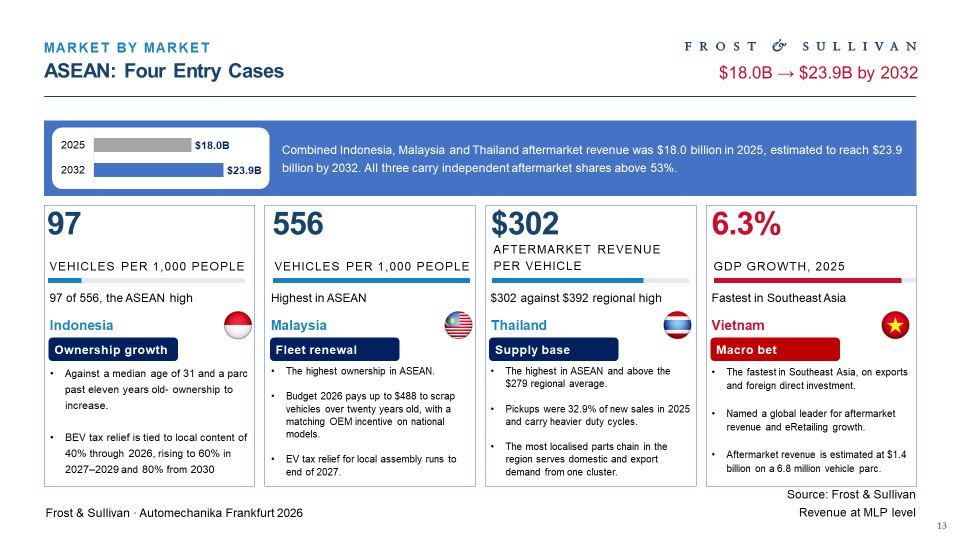
This is where my own presentation's argument enters the picture. China's aftermarket alone was worth $97.2 billion in 2025 and is projected to reach $173.6 billion by 2032, an 8.6 percent compound annual growth rate and the single largest absolute revenue gain of any market in this study, built on a vehicle parc of 348.8 million units that is aging rather than shrinking, thanks to an extended scrappage threshold. Add Indonesia, Malaysia and Thailand, three genuinely distinct entry cases (Indonesia driven by rising vehicle ownership, Malaysia by fleet renewal, Thailand by its position as the region's export capable supply base) and combined ASEAN aftermarket revenue climbs from $18.0 billion to nearly $23.9 billion over the same period.
That accounts for demand. Supply is already moving in the opposite direction, into Europe. Chinese battery and vehicle manufacturers are opening plants in Hungary and starting trial production lines built explicitly to serve European original equipment manufacturers. At the show itself, the number of Chinese exhibitors has roughly quadrupled within a single two year cycle.
“China is not simply becoming the world's largest EV market. It is becoming the world's largest transition market, from a mechanical aftermarket toward one defined by software, electronics and electrification. And because of its scale, what happens in China will increasingly shape global parts supply, whether or not you have a single customer there today.”
That was the message I left the Frankfurt audience with, and it still holds. Given the scale involved, what happens inside China's aftermarket will increasingly set the terms for global parts supply, regardless of whether any given supplier currently has a single customer there.
What This Means for the Next Move
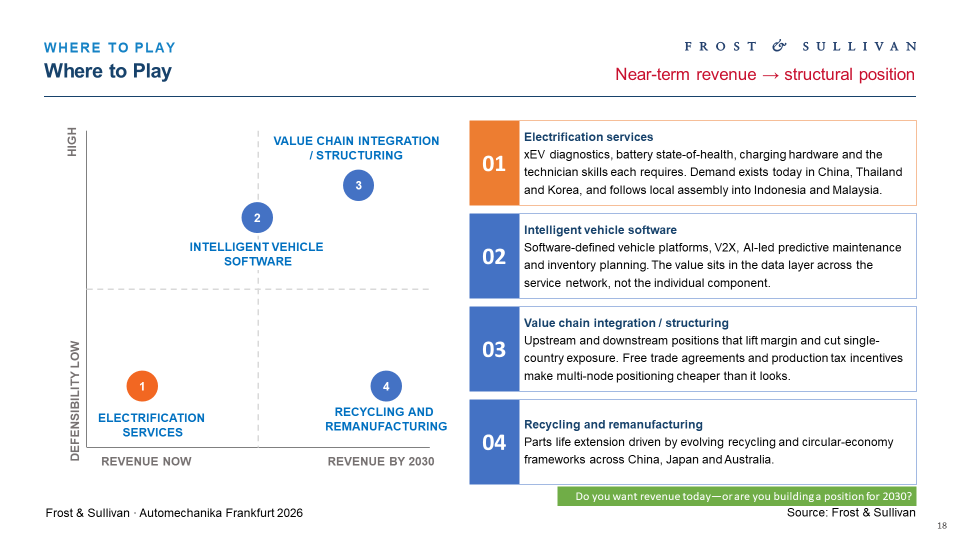
Taken together, these are not six unrelated observations from a single conference. They describe one coherent transition. The parts mix is moving from mechanical to electronic. The service model is moving from scheduled bay visits to continuous software updates. Manufacturers are fighting harder, and with far more sophisticated tools, to retain the repair relationship once a vehicle leaves the factory. And the suppliers who will define the next generation of components are no longer concentrated in Europe and North America. None of this is a scenario penciled in for 2030. It is already visible in this year's data, which means the window for repositioning is open now, not later.
Where the Conversation Continues
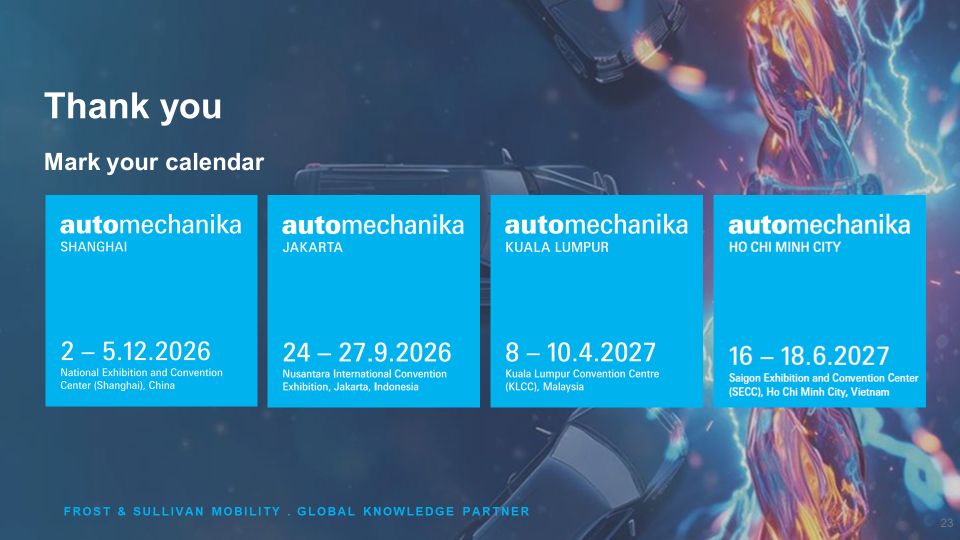
For anyone whose roadmap intersects with any part of this, the Automechanika calendar across Asia, where Frost & Sullivan's Mobility practice continues as Global Knowledge Partner, is worth watching closely. Shanghai returns from December 2 to 5, 2026; last year's edition drew 253,691 visitors from 190 countries and regions across 390,000 square meters and 16 halls, with 46,000 square meters dedicated solely to New Energy and Connectivity. Jakarta has just completed its inaugural edition. Kuala Lumpur follows from April 8 to 10, 2027, and Ho Chi Minh City from June 16 to 18, 2027, each drawing exhibitors and visitors from more than fifty countries into markets that are still very much being built.